Satadal “Sata” Sengupta
Postdoctoral Fellow in Networked Systems + AI at the University of Texas at Austin
Research Overview
I build systems that enable networks to actively “boost” Internet applications. My research combines Internet measurement with programmable network platforms to provide real-time visibility into application behavior, enabling operators to detect problems early and intervene immediately to improve security, performance, and scalability.
Concretely, I have developed systems for continuously monitoring round-trip latency
(SIGCOMM 2022),
detecting stealthy routing attacks in real time (NINeS 2026),
and scaling video conferencing through in-network offload (IMC 2022,
SIGCOMM 2025).
I am now building on this foundation to pursue AI-driven network control,
with the goal of making networks more adaptive and autonomous while maintaining
strong safeguards for safety, robustness, and operator trust. This agenda is
further informed by my earlier work in ML-based traffic classification
(Web Conference 2019)
and video QoE enhancement (ICNP 2018).
About me
I am a Postdoctoral Fellow working at the intersection between networked systems and AI at the University of Texas at Austin, advised by Aditya Akella and collaborating closely with Daehyeok Kim. I graduated with a Ph.D. in Computer Science from Princeton University, advised by Jennifer Rexford and collaborating closely with Ravi Netravali and Maria Apostolaki. My work has appeared at leading venues including SIGCOMM, IMC, and The Web Conference, and has been featured in the networking community (APNIC Post 1, Post 2). I have also collaborated with Princeton’s Office of Information Technology, using anonymized data and operational insight from Princeton’s campus network throughout my research. During my Ph.D., I was also a three-time research intern at Netflix, where I worked on optimal server placement for cloud gaming, and estimating latency asymmetry from global-scale measurements. Before Princeton, I earned a Master's by Research in Computer Science and Engineering from IIT Kharagpur, India.
Research Highlights
The projects below highlight one flagship example at each of three levels of the “network-boosted applications” vision. DART shows how programmable networks can provide deep visibility into application behavior, HiDe shows how that visibility can drive real-time intervention, and Scallop shows how the network can go one step further by directly offloading application functionality into network hardware.
1 Deep Visibility at Production Scale
DART: Continuous In-Network Round-Trip Time Monitoring
ACM SIGCOMM 2022
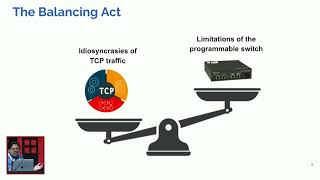
Round-trip time (RTT) is a valuable signal for diagnosing network problems because it can reveal emerging congestion, application slowdown, and routing attacks. However, relying on endpoints alone is often not enough. First, endpoints see only their own flows and have no visibility into the broader traffic conditions around them. Second, by the time they react, the damage to user experience or security may already be done. Measuring RTT from within the network would address both limitations, since the network can observe many flows at once and intervene from a broader vantage point. But doing so continuously and at scale is difficult. TCP creates a natural opportunity for in-network RTT measurement because acknowledgments can, in principle, be matched with data packets to compute RTT continuously. Yet the same mechanisms that make TCP reliable and efficient also make this hard. Retransmissions and packet reordering can make packet matches ambiguous, while cumulative acknowledgments make it difficult to know when stale packet records can be safely evicted to reclaim memory. DART addresses these challenges by keeping only a short per-flow summary and a few detailed packet records, allowing it to measure RTT continuously within the tight memory limits of terabit-scale programmable switches. DART is the first system to measure RTT continuously, accurately, and at scale from within the network, enabling real-time intervention. On campus traffic, DART recovered 99% of the RTT samples produced by an offline software baseline that has access to unlimited memory.
2 Closing the Loop with Real-Time Intervention
HiDe: Passive Data-Plane Telemetry to Mitigate Long-Distance BGP Hijacks
NINeS 2026
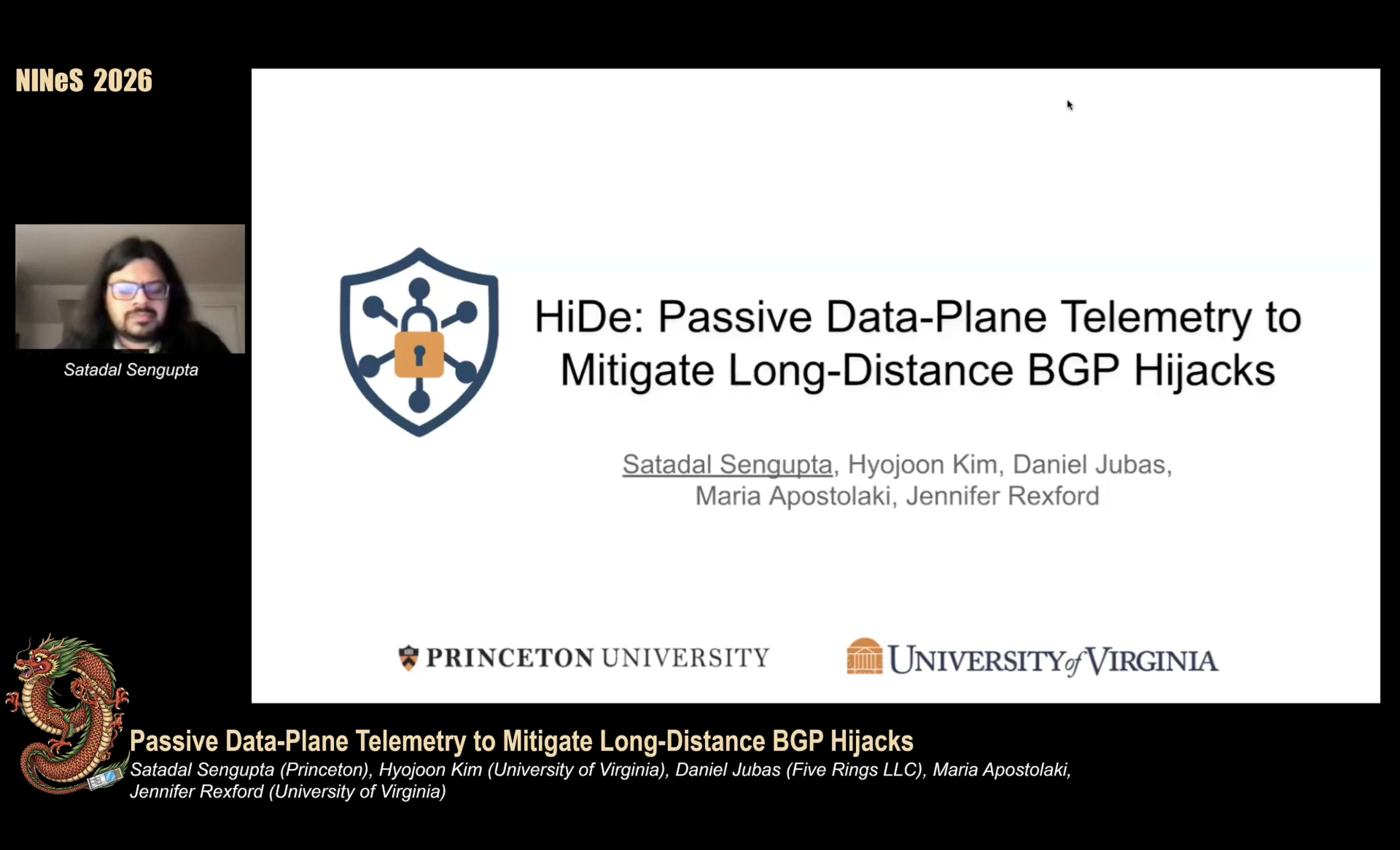
Long-distance BGP hijacks can reroute user traffic through unintended jurisdictions, exposing it to surveillance and bypassing legal privacy protections. Attackers often need only a few seconds of diverted traffic to infer browsing activity or steal credentials and other sensitive information, so rapid detection is essential. Yet existing control-plane-based defenses can miss these attacks or respond too slowly. HiDe instead detects long-distance hijacks from within the network by using passively monitored RTT as a real-time signal of suspicious route changes. This works because large geographic detours necessarily inflate propagation delay, and we show that this signal applies to most cross-country attacks in practice. However, turning RTT into an accurate detector is difficult: even benign conditions such as congestion and routine route changes can cause large delay variation. HiDe addresses this challenge by using the minimum RTT per prefix as a denoised signal and applying hardware-friendly change detection to identify suspicious route changes. Implemented on a programmable switch, HiDe detected ethically conducted real-world hijacks within 500 ms and maintained a false-positive rate below 0.012% on 12 hours of campus traffic.
3 Offloading Application Logic into the Network
Scallop: Scalable Video Conferencing Using SDN Principles
ACM SIGCOMM 2025
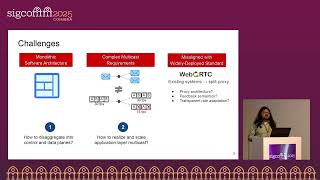
Selective forwarding units (SFUs) are the core building block of modern video-conferencing systems: they relay media among participants and adapt media quality to match each receiver's network conditions. Their workloads are highly dynamic as users join or leave meetings, mute or unmute, start or stop screen sharing, and so on. As demand for video conferencing rises, today's software SFUs can become a bottleneck, introducing jitter and degraded media quality and threatening to become increasingly costly to scale in the future. Scallop starts from the observation that the most frequent, latency-sensitive SFU tasks—such as packet replication and selective forwarding—closely resemble traditional packet-processing operations. It leverages this insight through a hardware-software co-design implemented on programmable switches and SmartNICs: high-volume media operations run on network hardware, while infrequent control tasks such as rate control and session management remain in software. Despite the challenges of efficient replication, per-receiver media adaptation, and preserving backward compatibility with existing browser clients, Scallop's switch prototype handles 99% of bytes entirely in hardware, supports up to 128,000 concurrent meetings on a single switch, and improves scaling by 10-200x over a 32-core commodity server at the same cost.